
To tame task overload with the Eisenhower Matrix, start by categorizing your tasks into four quadrants: urgent & important, not urgent & important, urgent & not important, and neither urgent nor important. Focus on high-priority tasks and delegate or eliminate less critical ones. Use visual cues like color coding and review your matrix regularly to stay aligned with your goals. Keep practicing these strategies for better decision-making and productivity—more tips await to help you master this powerful tool.
Key Takeaways
- Categorize tasks into four quadrants: urgent & important, not urgent & important, urgent & not important, neither, for clear prioritization.
- Focus on Quadrant 1 and 2 tasks to address critical needs and strategic goals, reducing overload.
- Delegate or postpone tasks in Quadrants 3 and 4 to free up time for high-priority activities.
- Regularly review and update your matrix to adapt to changing priorities and avoid task backlog.
- Incorporate the matrix into daily routines to enhance decision-making and prevent overwhelming workloads.
Understanding the Eisenhower Matrix

The Eisenhower Matrix is a powerful tool that helps you prioritize tasks based on their urgency and importance. It streamlines your decision making and prevents you from wasting time on less critical activities. By categorizing tasks into four quadrants, you can quickly identify what needs immediate attention and what can be delegated or postponed. This approach enhances your task prioritization skills, ensuring that important deadlines aren’t missed. When you understand how to use the matrix effectively, you’ll make smarter choices about where to focus your energy. It simplifies complex decisions about workload, helping you stay organized and reduce overwhelm. Ultimately, the Eisenhower Matrix empowers you to work more efficiently and achieve your goals with clarity and purpose.
The Four Quadrants Explained

Have you ever wondered how to quickly determine which tasks deserve your immediate attention? That’s where the four quadrants of the Eisenhower Matrix come into play through priority mapping and quadrant analysis. The matrix splits tasks into four categories: urgent and important, important but not urgent, urgent but not important, and neither urgent nor important. Each quadrant helps you visualize where your focus should go. Quadrant 1 covers critical tasks requiring immediate action, while Quadrant 2 emphasizes strategic, long-term goals. Quadrant 3 involves distractions, and Quadrant 4 includes time-wasting activities. Understanding these quadrants allows you to allocate your time effectively, ensuring you tackle high-priority tasks first. This clear quadrant analysis simplifies decision-making and keeps your workload manageable. Recognizing the importance of visual clarity in contrast ratio can help you prioritize tasks related to optimizing your workspace for better focus. Additionally, implementing vertical storage solutions can further enhance organization and reduce clutter, making it easier to identify and address urgent tasks promptly. Incorporating advanced segmentation techniques from email marketing can help prioritize outreach efforts and tailor your communication strategies more effectively.
Identifying Urgent vs. Important Tasks
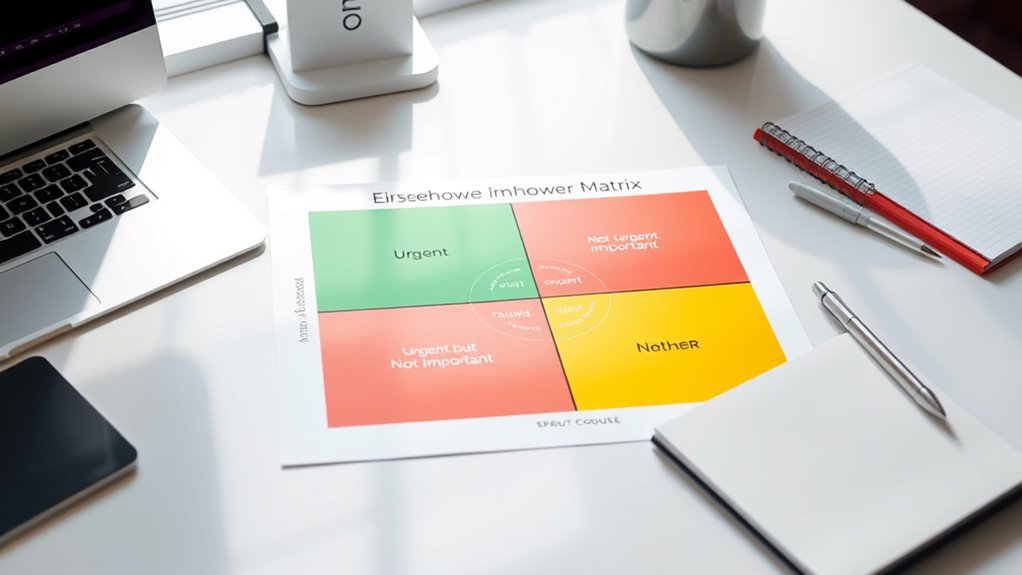
Understanding the difference between urgent and important tasks is essential for effective prioritization. Urgent tasks demand immediate attention and often come with tight deadlines, making deadline management critical. Important tasks, however, contribute to your long-term goals and overall success. To distinguish between them, consider your decision criteria: Does this task align with your values or objectives? Will neglecting it cause setbacks? If the task requires quick action to prevent negative consequences, it’s urgent. If it’s fundamental for growth or planning, it’s significant. Recognizing this distinction helps you avoid spending too much time on urgent tasks that don’t truly matter, enabling you to focus on what advances your priorities and reduces overall stress. Properly identifying these types ensures better decision-making and task management.
Setting Up Your Matrix

Creating an effective task matrix begins with clearly defining your categories and setting up a grid that reflects your priorities. Start by choosing labels for each quadrant—such as Urgent & Important, Not Urgent & Important, and so on. A visual setup helps you quickly grasp your tasks at a glance. Use color coding to distinguish each section; for example, red for urgent tasks and green for less critical ones. This makes your matrix more intuitive and easier to interpret. Organize your categories in a simple 2-column, 3-row table like this:
| High Priority | Low Priority | |
|---|---|---|
| Urgent & Important | ||
| Not Urgent & Important |
This setup streamlines your focus and simplifies task management. Additionally, understanding task prioritization is crucial for effective time management. To enhance your matrix’s effectiveness, consider visual organization techniques that help you better categorize and address tasks based on urgency and importance. Incorporating a clear categorization system can further improve your ability to allocate time efficiently. Moreover, integrating AI tools for task management can automate and optimize your prioritization process, saving you time and reducing overload.
Prioritizing and Delegating Effectively

To manage your workload effectively, you need to distinguish between tasks that are urgent and those that are important. Developing strong delegation strategies allows you to free up time for high-priority work without sacrificing quality. Balancing these priorities guarantees you stay productive without feeling overwhelmed.
Distinguishing Urgent From Important
When managing your workload, the key is to differentiate between tasks that are urgent and those that are important, as they demand different approaches. Recognizing this distinction helps you avoid constant firefighting. Use decision making frameworks like the Eisenhower Matrix to categorize tasks effectively. Emotional intelligence plays a role by helping you assess the true impact of each task, rather than reacting impulsively. Here are three tips:
- Ask yourself if the task aligns with your long-term goals or values.
- Identify deadlines versus significance—urgent might be immediate, but important shapes your future.
- Regularly review your priorities to prevent urgent tasks from overshadowing important ones.
This clarity allows you to focus on what truly matters, managing tasks with confidence and purpose.
Effective Delegation Strategies
Effective delegation begins with understanding how to prioritize tasks so you can assign the right responsibilities to the right people. When you identify tasks that align with team strengths and decision making processes, collaboration improves and workload decreases. To do this effectively, consider the following:
| High Priority | Low Priority |
|---|---|
| Critical tasks | Routine tasks |
| Strategic goals | Administrative |
Focusing on tasks that truly matter ensures your team works efficiently and reduces overload. Clear communication and trust are key in team collaboration, allowing team members to take ownership. By delegating appropriately, you empower others and streamline decision making, ensuring your workload stays manageable and projects move forward smoothly. Additionally, understanding the best vacuums for hardwood floors can help you maintain a clean workspace, further reducing distractions and inefficiencies. Incorporating effective prioritization techniques can also enhance your delegation strategy for better results.
Balancing Workload Priorities
Balancing workload priorities requires a strategic approach to both prioritizing tasks and delegating responsibilities. To manage your time effectively and reduce stress, focus on clear priorities. Here are three tips:
- Use the Eisenhower Matrix to identify urgent and important tasks, ensuring you tackle high-priority items first.
- Delegate tasks that others can do, freeing your time for critical responsibilities.
- Regularly review your task list to adjust priorities as needed, preventing overload and maintaining focus.
Common Mistakes to Avoid

One common mistake people make when managing multiple tasks is overcommitting without evaluating their actual capacity. This often leads to overcomplicating tasks, making them seem more intimidating than necessary, which can cause unnecessary stress and delays. Another pitfall is neglecting review; you might set priorities but forget to revisit and adjust them as circumstances change. Overcomplicating tasks can divert your focus from what’s truly important, while neglecting review prevents you from catching misaligned priorities early. To avoid these mistakes, keep tasks simple and clear, and regularly reassess your priorities. Incorporating regular review into your workflow helps you stay on track and adapt to changing circumstances, preventing misaligned priorities from derailing your progress. Additionally, being mindful of mental clarity and health can support better decision-making and task management, helping you effectively manage your workload without falling into common traps. Recognizing the potential security vulnerabilities in new systems allows you to take proactive steps to protect your data and maintain trust. Understanding the importance of diversifying investments like gold can also provide a stable foundation, reducing overall stress when managing financial priorities.
Practical Examples of Task Categorization

Categorizing tasks clearly can considerably improve your workflow by helping you prioritize and allocate your time more efficiently. When you assign tasks to specific Eisenhower Matrix quadrants, you streamline your decision-making process, leading to better time management and less stress. For example:
- Urgent and Important: Handle pressing work deadlines or emergencies immediately to prevent last-minute stress.
- Important but Not Urgent: Schedule strategic planning or skill development, reducing future stress and boosting productivity.
- Urgent but Not Important: Delegate routine emails or calls to free up time for more meaningful tasks.
- In the context of arcade gaming, understanding how to balance quick reflexes with strategic planning can enhance both gameplay and task management, illustrating the importance of game performance hardware in achieving optimal results.
Additionally, incorporating task prioritization techniques helps in maintaining focus on what truly matters, whether in daily responsibilities or leisure activities, and understanding time management strategies can further improve efficiency.
Integrating the Matrix Into Your Daily Routine
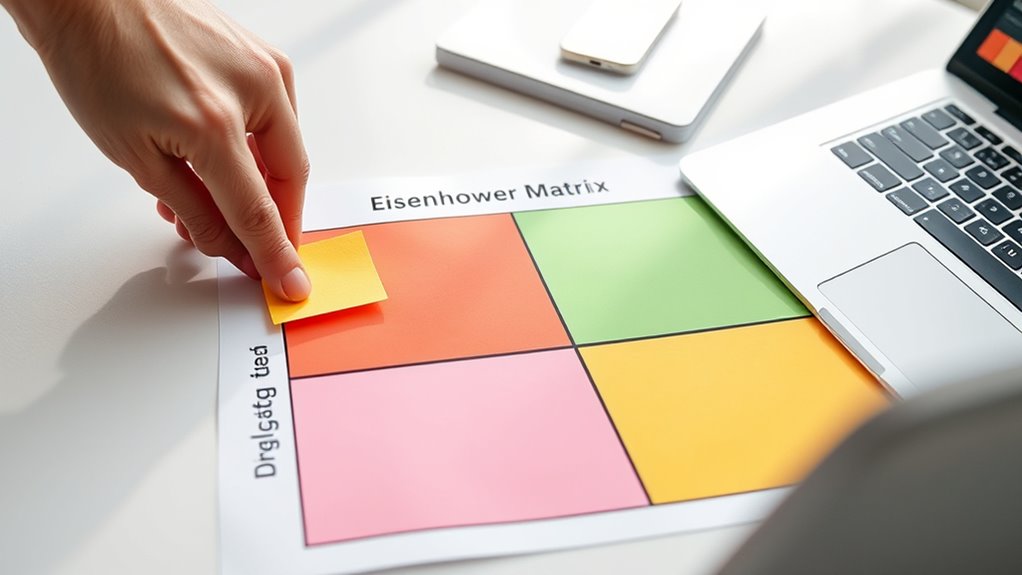
Once you’ve learned how to categorize tasks effectively, the next step is making the Eisenhower Matrix a natural part of your daily routine. Incorporate it into your morning planning or during your breaks to enhance your time management. Use the matrix to quickly evaluate new tasks, helping you decide what to prioritize or delegate. Consistent use reduces decision fatigue and keeps you focused on what’s urgent and important. As you integrate the matrix into your daily habits, you’ll notice a decrease in stress because you’re managing tasks proactively rather than reactively. Over time, this routine becomes second nature, empowering you to handle workload efficiently. Additionally, practicing mindfulness during your task assessment can improve your mental clarity and decision-making skills. By embedding the matrix into your day, you create a structured approach that supports clearer priorities and a more balanced, less stressful work life.
Tips for Maintaining Long-Term Productivity

To keep your productivity sustainable, you need to focus on key habits that support long-term success. Regularly prioritizing tasks, setting clear goals, and balancing work with rest help prevent burnout and keep you motivated. Incorporate these tips into your routine to stay productive without sacrificing your well-being.
Prioritize Regularly
Because priorities can shift over time, regularly reviewing and adjusting them helps you stay focused on what truly matters. This keeps your time management effective and reduces stress. To stay on track, consider these tips:
- Set aside a weekly review to reassess your tasks, making sure you’re focusing on high-priority items.
- Adjust deadlines and commitments as needed, so you avoid unnecessary pressure and overload.
- Celebrate small wins to stay motivated and reinforce your sense of progress.
Set Clear Goals
Setting clear goals is essential for maintaining long-term productivity because it provides you with a focused roadmap and measurable milestones. When you engage in goal setting, you stay motivated and track progress effectively. Break down big objectives into smaller, actionable steps to stay on course. Use motivation strategies like visualizing success or rewarding yourself to keep momentum. Regularly review your goals to adapt and stay aligned with your priorities. Here’s a simple guide:
| Goal Type | Example | Motivation Strategy |
|---|---|---|
| Short-term | Complete a task today | Celebrate small wins |
| Long-term | Finish a project in 3 months | Visualize achievement |
| Personal | Improve skills | Track progress |
| Professional | Earn a promotion | Set milestones |
| Wellness | Exercise regularly | Set rewards |
Clear goals fuel your productivity engine.
Balance Work and Rest
Balancing work and rest is essential for sustaining long-term productivity, as neglecting either can lead to burnout or decreased performance. Prioritize regular rest and recovery to maintain mental well-being and avoid exhaustion. To help you achieve this balance, consider these tips:
- Schedule breaks throughout your workday to recharge and clear your mind.
- Incorporate activities that promote relaxation, like meditation or walking, to support mental well-being.
- Set boundaries to ensure you disconnect after work hours, allowing your mind to fully rest.
Frequently Asked Questions
How Often Should I Reassess My Task Priorities?
You should conduct a priority review and modify your scheduling frequency at least once a week. Regular reassessment helps you stay aligned with your goals and adapt to any changes in urgency or importance. If your workload fluctuates, consider reviewing your tasks more frequently, maybe every few days. This way, you stay proactive, manage your time effectively, and guarantee you’re focusing on the right tasks at the right moments.
Can the Eisenhower Matrix Be Used for Team Task Management?
The Eisenhower Matrix can boost your team’s collaboration and clarity by visualizing tasks. You’ll assign priorities, delegate effectively, and distinguish urgent from important work. When used for team task management, it fosters focus, minimizes chaos, and promotes clear communication. By categorizing team tasks into quadrants, you ensure everyone understands their roles and responsibilities, making delegation more effective and teamwork more seamless.
What Tools Can Help Implement the Eisenhower Matrix Digitally?
You can use various digital apps and productivity tools to implement the Eisenhower Matrix easily. Apps like Todoist, Trello, and Microsoft To Do offer built-in features or customizable boards that help you categorize tasks by urgency and importance. These tools enable you to prioritize, set deadlines, and track progress efficiently. By integrating these digital solutions, you streamline your workflow and make managing tasks more effective and less overwhelming.
How Do I Handle Tasks That Are Both Urgent and Important?
When you face tasks that are both urgent and important, act quickly to address them, as they hold high priority. Focus on completing these tasks first to prevent them from escalating. If possible, delegate parts of the task that others can handle, ensuring you stay efficient. Recognizing urgent importance helps you manage your workload better and keeps you from feeling overwhelmed, maintaining your productivity and focus.
Is the Eisenhower Matrix Effective for Long-Term Planning?
You might think the Eisenhower Matrix is only for daily tasks, but it actually enhances long-term planning. It helps you prioritize effectively, ensuring important goals don’t get lost in the shuffle. By incorporating this matrix into your prioritization strategies, you stay focused on what truly matters over time. So, yes, it’s a powerful tool for managing both immediate needs and your long-term vision, making your planning more intentional and successful.
Conclusion
Think of the Eisenhower Matrix as your personal navigation system, guiding you through the chaos like a seasoned captain steering clear of storms. When you prioritize wisely, you turn overwhelm into clear waters. Just like a chef perfectly balances ingredients for a delicious dish, balancing your tasks keeps your productivity flavorful and sustainable. Embrace the matrix daily, and you’ll sail smoothly toward your goals, avoiding the whirlpools of task overload.