
TL;DR

Get beauty and skincare favorites delivered free with Prime
- Fast, free delivery on millions of items
- Prime Video, Amazon Music and more included
- Member-only deals all year
Haut.AI released SkinBench on October 27, 2026, reporting that six AI models often identified skin concerns that were absent. In the benchmark, they reported eye puffiness in about 95% to 100% of images where it was not present. The results highlight the need to test separate capabilities such as false detections, feature location and performance across skin tones.
Six AI models frequently reported skin concerns that were not present in images tested by SkinBench, a benchmark released by skincare technology company Haut.AI on October 27, 2026. The company said the models reported eye puffiness in approximately 95% to 100% of images where it was absent, raising questions about whether general-purpose AI can reliably measure skin for consumer advice and beauty services.
Developed by Haut.AI’s Data Science team, SkinBench runs 19 tests across seven skin concerns and characteristics. The supplied report names wrinkles, sun spots, redness, skin tone, skin type, dark circles and eye puffiness among the areas assessed. Haut.AI says the six leading models often both reported concerns that were not visible and struggled to locate features they did identify.
The eye-puffiness finding is a false-detection result: the models reported a concern in images for which it was absent. That matters differently from failing to identify a real feature. A system can sound convincing when describing a photo while still making an incorrect judgment about whether a condition is present or where it appears. The report argues that image description alone does not establish that a model can measure skin reliably.
SkinBench was released alongside Haut.AI’s Skin Foundation Model, or SkinFM. The available source material does not provide the names of the six tested models, their individual scores across all 19 tests, or the full benchmark protocol. The reported eye-puffiness range should therefore be read as the result presented for the tested images, not as a universal rate for every model or real-world use.
False Detections Can Mislead Shoppers
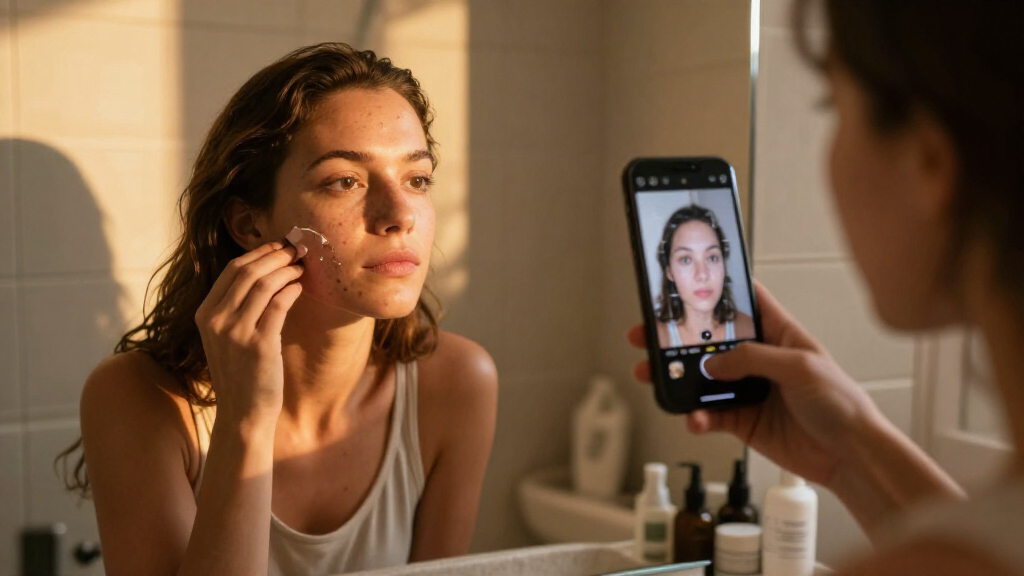
The finding is relevant to beauty companies using AI to assess skin and recommend products. If software reports a concern that is not present, a recommendation system could steer a customer toward a product for a need they do not have. That could weaken confidence in the analysis, particularly when a result conflicts with what the customer sees in the mirror.
False detections can also affect progress tracking. If a system records a concern that was never present, later comparisons may imply improvement or change without a reliable starting point. For brands making claims about skin measurement or product results, a single overall accuracy score may not reveal these weaknesses.
Consumer interest makes the reliability question commercially relevant, though the survey figures cited in the source do not show that those consumers used the tested models. NielsenIQ found that 49% of consumers had taken beauty product recommendations from generative AI, while Accenture found that 75% of beauty consumers were open to an AI-powered shopping experience. A Haut.AI survey of 1,238 U.S. women found 62% interested in or already using AI for skincare or bodycare advice. These figures indicate interest, not proof that AI skin assessments are accurate.
Popular right now

Dyson Ball Animal Total Clean Upright Vacuum

De’Longhi Classic Matte Black Espresso Machine with Milk Frother

Shark Rocket Pet Plus Corded Stick Vacuum, Bordeaux, HV322
As an affiliate, we earn on qualifying purchases.
Skin Analysis Requires Several Tests
Skin analysis is not one task. A system may need to determine whether a concern exists, grade its severity, locate it on the face, classify skin type and perform consistently across different complexions. A blended score can conceal uneven performance across those tasks. For example, product advice based on skin type depends on distinguishing dry, oily and combination skin, while measuring a wrinkle over time requires locating it consistently.
The source argues that buyers should look beyond average accuracy and ask for false-detection rates, feature localization, balanced skin-type scores and results for the weakest-performing skin-tone group. It also recommends comparing a system’s agreement with expert assessments against the level of agreement experts reach with one another, and checking repeatability when the same image or skin is analyzed again under the same conditions.
As a separate reference, the source says Haut.AI’s own skin-measurement technology was evaluated in a study conducted at Institut d’Expertise Clinique in France against a consensus panel of expert graders. It reports repeatability of ICC 0.97 to 0.98 across five facial skin endpoints. That figure concerns Haut.AI’s technology and the cited study; it is not a SkinBench score for the six general-purpose models.
Benchmark Details Still Missing
The supplied report does not identify the six models, publish their individual results for all 19 tests, or describe the number and makeup of images used for each test. It also does not provide enough information here to independently assess the reference labels, scoring rules, or whether the images represent the range of conditions found in consumer use. Those details are needed to judge how broadly the eye-puffiness result applies.
The reported range of approximately 95% to 100% is tied to images where puffiness was absent, but the source material does not state the sample size or a comparison baseline. The rate should not be interpreted as a general failure rate for all images or all AI skin-analysis systems. SkinBench’s results also do not, on their own, establish how the models perform when used by consumers, under different lighting, or with different cameras.
Published Methods Will Shape Scrutiny
The next step for readers and potential buyers is to examine the benchmark’s underlying methodology and results as they become available: the tested image set, expert reference assessments, scoring rules, model list and task-by-task scores. Those disclosures would allow comparisons beyond the headline eye-puffiness result and help determine whether performance varies by concern, skin tone or analysis task.
For companies choosing an AI skin-analysis system, the report’s practical test is to request separate results for each capability, rather than relying on one blended accuracy figure. SkinBench’s release places those questions on the table, but the supplied material does not state a date for further results or independent replication. Until more detail is available, the scale and generalizability of the reported failures remain open.
Key Questions
What is SkinBench?
SkinBench is an AI skin-analysis benchmark released by Haut.AI on October 27, 2026. The company says it tests six AI models through 19 tests covering seven skin concerns and characteristics.
What did the models get wrong?
Haut.AI reported that the models often identified concerns that were not present and struggled to locate features they did identify. In images where eye puffiness was absent, they reported puffiness in approximately 95% to 100% of cases, according to the supplied report.
Does the finding apply to every AI skin-analysis tool?
No such conclusion is established by the source material. The finding concerns six tested models; the model names, full results and testing details are not supplied here. It should not be treated as a general failure rate for all tools.
Why do false detections matter to consumers?
A false report could lead to a product recommendation for a concern that is not present. It may also make later skin comparisons less meaningful if the initial assessment was inaccurate.
What information would help verify the results?
Readers would need the model list, image set and sample sizes, expert reference assessments, scoring rules and individual results for each test. These details would clarify how the findings were produced and how far they can be applied beyond the benchmark.
Source: rss