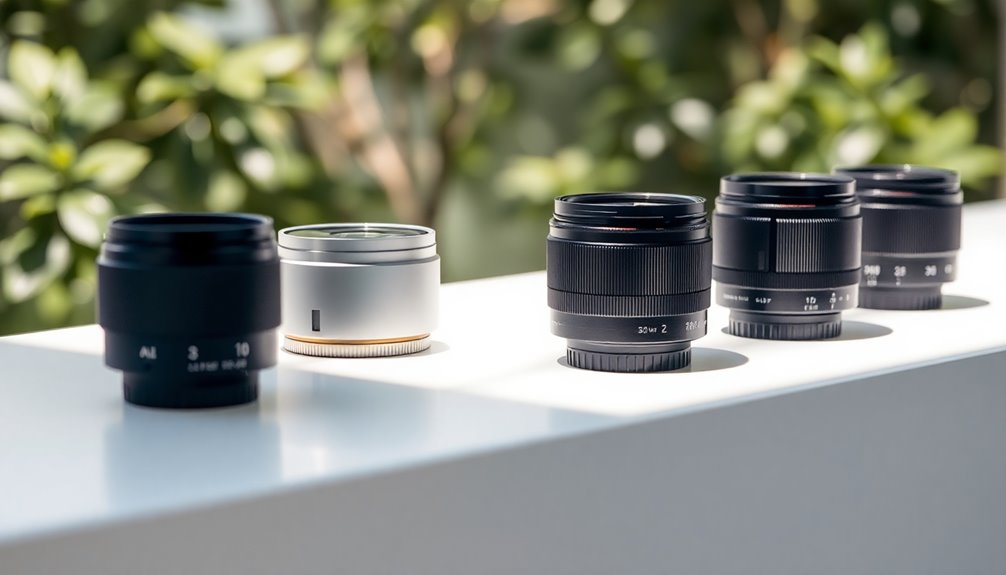

Minimalist camera lenses favor a compact kit and simple shooting over maximum versatility. My best overall pick is the Fujifilm Fujinon XF 27mm F2.8, which pairs a small pancake form with autofocus; the Canon RF 50mm F1.8 STM is a standout for RF users who want a bright everyday prime, while the Canon RF 16mm f/2.8 STM suits wide-angle work in a compact package. The main tradeoffs are autofocus versus manual control, a bright aperture versus a thinner profile, and practical image-making versus the distinctive limits of fixed-focus f/10 designs. Mount compatibility matters just as much as size, since these lenses are not interchangeable across camera systems. Continue reading for the full breakdown and help matching a minimalist lens to your camera and style.

Get beauty and skincare favorites delivered free with Prime
- Fast, free delivery on millions of items
- Prime Video, Amazon Music and more included
- Member-only deals all year
Complete the kit


Key Takeaways
- The Fujifilm XF 27mm F2.8 leads for compact everyday use because it combines a pancake profile with autofocus, unlike the manual and focus-free options.
- Bright apertures add more than low-light flexibility: the Canon RF 50mm f/1.8, Sony FE 50mm f/1.8, and Panasonic 25mm f/1.7 give more control over background blur than the f/10 pancake lenses.
- Mount compatibility narrows the field immediately. A lens designed for Canon RF, Sony E, Micro Four Thirds, Fujifilm X, Canon EF, or Nikon F is not a universal minimalist option.
- Fixed-focus f/10 pancakes prioritize simplicity over flexibility. The Bitubol and focus-free styles reduce setup fuss but give up aperture control and close-focus versatility compared with autofocus primes.
- Manual-focus TTArtisan lenses offer a deliberate, lower-tech approach with bright or compact options, but they are less suited to fast-moving subjects than autofocus alternatives.
| Canon EF 50mm f/1.8 STM Lens for EOS DSLR Cameras |  | Best Lightweight DSLR Portrait Prime | Focal length: 50mm | Maximum aperture: f/1.8 | Mount: Canon EF | VIEW ON AMAZON | See Our Full Breakdown |
| SG-image AF25mm f/1.8 Autofocus Prime Lens for Micro Four Thirds, Black |  | Best Compact Micro Four Thirds Everyday Prime | Focal length: 25mm (50mm equivalent) | Maximum aperture: f/1.8 | Minimum aperture: f/16 | VIEW ON AMAZON | See Our Full Breakdown |
| Bitubol 30mm F/10 Fixed-Focus Pancake Lens for Canon RF |  | Best Ultra-Light Creative Effect Lens | Focal length: 30mm | Aperture: Fixed f/10 | Focus type: Fixed focus | VIEW ON AMAZON | See Our Full Breakdown |
| Canon RF 50mm F1.8 STM Lens |  | Best Native RF Portrait Prime | Focal length: 50mm | Maximum aperture: f/1.8 | Lens type: Prime | VIEW ON AMAZON | See Our Full Breakdown |
| Retropia Repurposed Disposable Camera Lens for Sony E-Mount, 32mm f/11 |  | Best for a Nostalgic, No-Edit Look | Mount: Sony E-mount | Focal length: 32mm | Aperture: Fixed f/11 | VIEW ON AMAZON | See Our Full Breakdown |
| Canon RF 16mm f/2.8 STM Lens |  | Best Compact Ultra-Wide | Focal length: 16mm | Maximum aperture: f/2.8 | Lens type: Ultra-wide-angle prime | VIEW ON AMAZON | See Our Full Breakdown |
| TTArtisan 50mm f/1.2 APS-C Manual Focus Lens for Micro Four Thirds |  | Best for Manual-Focus Portraits | Focal length: 50mm | Full-frame equivalent: 75mm | Maximum aperture: f/1.2 | VIEW ON AMAZON | See Our Full Breakdown |
| Retropia Repurposed 45mm f/10 Lens for Nikon F-Mount DSLR Cameras |  | Best for an In-Camera Vintage Look | Focal length: 45mm | Aperture: Fixed f/10 | Focus: Fixed focus; infinity focus beyond 1.5m | VIEW ON AMAZON | See Our Full Breakdown |
| TTArtisan 25mm f/2 APS-C Wide-Angle Manual Lens for Sony E-Mount |  | Best Compact Everyday Manual Prime | Focal length: 25mm | Full-frame equivalent: Approximately 37.5mm | Maximum aperture: f/2 | VIEW ON AMAZON | See Our Full Breakdown |
| Sony FE 50mm F1.8 Standard Lens (SEL50F18F/2), Black |  | Best Minimalist Full-Frame Standard Prime | Focal length: 50mm | Maximum aperture: f/1.8 | Mount: Sony E-mount | VIEW ON AMAZON | See Our Full Breakdown |
| Bitubol 32mm f/10 Fixed-Focus Pancake Lens for Sony E Mount |  | Best for No-Fuss Lo-Fi Snapshots | Focal length: 32mm | Aperture: Fixed f/10 | Focus: Fixed focus; depth of field stated from about 1.5 m to infinity | VIEW ON AMAZON | See Our Full Breakdown |
| Fujifilm Fujinon XF 27mm F2.8 Lens, Black |  | Best Compact Everyday Prime | Focal length: 27 mm | 35mm equivalent: 41 mm | Aperture range: F2.8–F16 | VIEW ON AMAZON | See Our Full Breakdown |
| Panasonic Lumix G 25mm f/1.7 ASPH Standard Prime Lens for Micro Four Thirds, Black (H-H025-K) |  | Best for Low-Light Autofocus | Focal length: 25 mm | 35mm equivalent: 50 mm | Aperture range: f/1.7–f/22 | VIEW ON AMAZON | See Our Full Breakdown |
| TTArtisan 25mm f/2 Manual Focus Lens for Micro Four Thirds |  | Best Manual-Focus Minimalist Prime | Focal length: 25 mm | Full-frame equivalent: 37.5 mm | Aperture range: f/2–f/16 | VIEW ON AMAZON | See Our Full Breakdown |
| 32mm f/10 Focus-Free Pancake Lens for Sony E-Mount Cameras |  | Best for Experimental Lo-Fi Style | Focal length: 32 mm | Aperture: Fixed f/10 | Focus: Focus-free | VIEW ON AMAZON | See Our Full Breakdown |
| minimalist camera lense | Focal length | Mount | Weight |
|---|---|---|---|
| Canon EF 50mm f/1.8 STM Lens f | 50mm | Canon EF | 5.6 oz (159 g) |
| SG-image AF25mm f/1.8 Autofocu | 25mm (50mm equivalent) | Micro Four Thirds | 133 g |
| Bitubol 30mm F/10 Fixed-Focus | 30mm | Canon RF | 35 g |
| Canon RF 50mm F1.8 STM Lens | 50mm | Canon RF | — |
| Retropia Repurposed Disposable | 32mm | Sony E-mount | — |
| Canon RF 16mm f/2.8 STM Lens | 16mm | — | — |
| TTArtisan 50mm f/1.2 APS-C Man | 50mm | Micro Four Thirds | 336g (330g also listed in item details) |
| Retropia Repurposed 45mm f/10 | 45mm | Nikon F | — |
| TTArtisan 25mm f/2 APS-C Wide- | 25mm | — | — |
| Sony FE 50mm F1.8 Standard Len | 50mm | Sony E-mount | — |
| Bitubol 32mm f/10 Fixed-Focus | 32mm | Sony E | 35 g |
| Fujifilm Fujinon XF 27mm F2.8 | 27 mm | Fujifilm X | 78 g |
| Panasonic Lumix G 25mm f/1.7 A | 25 mm | Micro Four Thirds | 125 g |
| TTArtisan 25mm f/2 Manual Focu | 25 mm | Micro Four Thirds | 166–189 g |
| 32mm f/10 Focus-Free Pancake L | 32 mm | Sony E | 35 g |
More Details on Our Top Picks
Canon EF 50mm f/1.8 STM Lens for EOS DSLR Cameras
For a minimalist DSLR kit, I’d choose this lens when I want one small prime that can handle portraits, everyday details, and dimmer indoor scenes. Its f/1.8 aperture gives it a clear low-light advantage over the fixed-f/10 Bitubol 30mm pancake, while the 159 g body keeps it easy to carry. STM autofocus is designed for quiet, smooth focusing, which is useful for video as well as stills. The tradeoff is the fixed field of view: unlike a zoom, it cannot quickly reframe, and on APS-C Canon bodies its view is equivalent to roughly 80mm, making indoor group shots harder. It is an EF DSLR choice, not a direct fit for Canon RF bodies like the RF 50mm F1.8 STM.
Pros:- Bright f/1.8 aperture supports low-light shooting and background separation.
- Compact 159 g design suits a lightweight everyday kit.
- STM autofocus is designed for quiet, smooth focusing in photos and video.
- Metal mount and reduced ghosting and flare are useful practical touches.
Cons:- Fixed 50mm framing cannot match the flexibility of a zoom.
- On APS-C bodies, the narrower equivalent view can be restrictive indoors.
- Requires a Canon EF mount; it is not the native RF option in this lineup.
Best for: Canon EF DSLR owners who want a compact portrait-friendly prime for available-light shooting and occasional video.
Not ideal for: APS-C DSLR users who often photograph groups or tight indoor spaces, and Canon RF mirrorless owners seeking a native-mount lens.
- Focal length:50mm
- Maximum aperture:f/1.8
- Mount:Canon EF
- Focus motor:Stepping motor (STM)
- Minimum focusing distance:1.15 ft (0.35 m)
- Maximum magnification:0.21x
- Filter size:49mm
- Dimensions:2.7 × 1.5 in (69.2 × 39.3 mm)
- Weight:5.6 oz (159 g)
Our verdict“Choose this EF prime for a light Canon DSLR kit when low-light ability and portrait framing matter more than zoom flexibility.”
SG-image AF25mm f/1.8 Autofocus Prime Lens for Micro Four Thirds, Black
The SG-image AF25mm makes sense for Micro Four Thirds photographers who want a small, normal-view lens with autofocus rather than a manual-focus minimalist setup. Its 25mm focal length gives a 50mm-equivalent view, while the f/1.8 aperture offers far more flexibility in dim light than the fixed-f/10 Retropia 32mm. At 133 g, it is a modest addition to a travel or street kit, and its STM motor is specified for quiet focusing that can suit video. The metal barrel and mount add a more substantial feel than the plastic-bodied Bitubol pancake, though the two serve very different purposes: this is the practical, flexible-light option, not an effect lens. Its main limitation is system exclusivity; it fits Micro Four Thirds cameras only, and the fixed focal length still asks you to move to change framing.
Pros:- 50mm-equivalent view suits general-purpose shooting.
- f/1.8 aperture supports lower-light use and background blur.
- 133 g weight and compact construction work well for travel.
- STM autofocus is intended to operate quietly for video.
Cons:- Fixed focal length requires repositioning to change composition.
- Micro Four Thirds mount limits use to compatible camera systems.
- Its conventional rendering may not appeal to buyers seeking a pronounced vintage effect.
Best for: Panasonic, Olympus, and OM System users seeking a lightweight autofocus prime for street, travel, and everyday scenes.
Not ideal for: Photographers who need zoom framing, use a non-Micro Four Thirds camera, or specifically want the soft, nostalgic rendering of a repurposed lens.
- Focal length:25mm (50mm equivalent)
- Maximum aperture:f/1.8
- Minimum aperture:f/16
- Mount:Micro Four Thirds
- Focus type:Autofocus with STM motor
- Angle of view:39.6 degrees
- Weight:133 g
- Filter size:52mm
- Included accessory:Metal square lens hood
Our verdict“Pick this lens for a compact Micro Four Thirds kit that needs autofocus and a bright, everyday field of view.”
Bitubol 30mm F/10 Fixed-Focus Pancake Lens for Canon RF
This is the most stripped-back option here: the Bitubol pairs a 35 g pancake body with fixed focus and a single f/10 aperture, aiming for quick, vintage-style street images rather than all-purpose performance. That simplicity can suit a Canon RF shooter who wants a tiny lens to leave on the camera for bright outdoor scenes. It is a very different proposition from the Canon RF 50mm F1.8 STM, which offers autofocus and a much brighter aperture for portraits and low light. The Bitubol’s fixed focus and fixed exposure opening reduce adjustment, but also remove control: it has no stabilization, is not water resistant, and offers little help in dim conditions. Its optical resin and PP plastic construction keeps weight down, though buyers wanting a conventional, dependable everyday prime should choose the Canon instead.
Pros:- Very light 35 g body is easy to carry as a minimalist add-on.
- Fixed-focus operation supports quick, simple shooting.
- Designed to produce a vintage film-style appearance.
- Canon RF mount targets EOS R system cameras.
Cons:- Fixed f/10 aperture gives little exposure flexibility and limits low-light use.
- No image stabilization is listed.
- Plastic exterior and lack of water resistance call for careful handling.
Best for: Canon RF photographers who prioritize the smallest possible carry setup and want a fixed-focus, vintage-style look in bright conditions.
Not ideal for: People shooting indoors, moving subjects, or scenes that need precise focus and exposure control; also a poor fit for wet-weather use.
- Focal length:30mm
- Aperture:Fixed f/10
- Focus type:Fixed focus
- Mount:Canon RF
- Lens material:Optical resin
- Exterior material:High-hardness PP plastic
- Dimensions:5.5 cm diameter × 2 cm thick
- Weight:35 g
- Image stabilization:None
Our verdict“Choose the Bitubol only if extreme lightness and an intentional vintage effect matter more than focus and exposure control.”
Canon RF 50mm F1.8 STM Lens
For Canon EOS R owners, this is the straightforward minimalist choice when a small kit still needs a bright, familiar prime. The 50mm f/1.8 combination supports background blur and available-light shooting, while STM autofocus is designed to keep focusing smooth and quiet for video. Compared with the EF 50mm f/1.8 STM elsewhere in this selection, this lens uses the native RF mount, avoiding the EF-to-RF compatibility question. It also does more for general photography than the fixed-f/10 Bitubol 30mm, but gives up that lens’s unusually tiny 35 g form and deliberate effect-driven simplicity. The central compromise is the fixed focal length: there is no zoom for quick changes in framing. The listed digital stabilization may help in compatible camera workflows, but this is still a compact prime, not a substitute for a stabilized zoom across varied scenes.
Pros:- Native Canon RF mount is made for EOS R system cameras.
- f/1.8 maximum aperture supports low-light shooting and background separation.
- Compact, lightweight prime design suits a pared-down kit.
- STM autofocus is designed for smooth, quiet photo and video focusing.
Cons:- Fixed 50mm focal length cannot adapt framing without moving.
- Less suitable than a wider lens for confined interiors or broad landscapes.
- Its conventional autofocus design is less stripped-down than fixed-focus effect options.
Best for: Canon EOS R photographers who want a native-mount, compact prime for portraits, everyday shooting, and low-light scenes.
Not ideal for: Travelers who need one lens to cover wide-to-telephoto framing, or buyers who want an ultra-light fixed-focus effect lens.
- Focal length:50mm
- Maximum aperture:f/1.8
- Lens type:Prime
- Mount:Canon RF
- Focus:Autofocus
- Focus motor:STM
- Angle of view:46 degrees
- Lens coating:Super Spectra Coating
- Image stabilization:Digital
Our verdict“Choose this as a compact native RF prime if you value bright-aperture versatility over zoom range or an experimental rendering.”
Retropia Repurposed Disposable Camera Lens for Sony E-Mount, 32mm f/11
The Retropia is for Sony E-mount photographers who want character and portability more than clean, adaptable optics. Its repurposed film-camera lens is designed to produce a soft, nostalgic look in photos and video without editing, making it a creative alternative to the SG-image AF25mm’s brighter, conventional autofocus approach. The fixed f/11 aperture keeps the concept simple but limits exposure options, especially in dim settings; it is better suited to bright scenes and deliberate experimentation than dependable all-day coverage. The 32mm focal length also differs from the Canon 50mm primes, giving a wider perspective than a standard portrait view, though the listed compatibility includes both full-frame and APS-C Sony E-mount cameras. The appeal is a ready-made aesthetic in a small package, but softness and small imperfections are part of the look, not defects every buyer will welcome.
Pros:- Repurposed film-camera optics provide an intentionally nostalgic rendering.
- Designed to create a distinctive look without post-processing.
- Compact, lightweight format supports portable, spontaneous shooting.
- Compatible with Sony E-mount full-frame and APS-C mirrorless cameras.
Cons:- Fixed f/11 aperture restricts exposure flexibility and low-light use.
- Soft blur and optical imperfections may not suit clean, detailed work.
- The supplied information does not specify autofocus, so buyers should not expect the convenience offered by the SG-image AF25mm.
Best for: Sony E-mount creators who want a lightweight lens for spontaneous street scenes and a soft, film-inspired look straight from camera.
Not ideal for: Photographers who need crisp detail, low-light flexibility, or adjustable aperture and focus for varied subjects.
- Mount:Sony E-mount
- Focal length:32mm
- Aperture:Fixed f/11
- Compatibility:Sony E-mount full-frame and APS-C mirrorless cameras
- Lens source:Repurposed film camera lenses
Our verdict“Pick the Retropia for a portable, in-camera vintage effect, not for sharpness, low-light versatility, or precise control.”
Canon RF 16mm f/2.8 STM Lens
For a minimalist kit that needs a genuinely wide view without a bulky zoom, the Canon RF 16mm f/2.8 STM is the most direct fit here. Its compact, lightweight build keeps an ultra-wide prime practical for everyday carry, while the f/2.8 aperture gives you more flexibility in dim interiors than the fixed-f/10 Retropia Repurposed 45mm lens. The gear-type STM autofocus is also a better match for video and moving subjects than the manual-focus TTArtisan 25mm f/2. The tradeoff is a fixed 16mm perspective: it is useful for architecture, interiors, and expansive scenes, but less adaptable for portraits or tighter framing. Canon RF full-frame compatibility is specific, and no weather sealing information is provided.
Pros:- Compact, lightweight design suits a pared-down camera kit.
- 16mm ultra-wide view fits interiors, architecture, and broad landscapes.
- f/2.8 maximum aperture is more useful in low light than fixed-aperture creative lenses.
- Quiet, smooth STM autofocus supports continuous video focusing.
Cons:- Fixed 16mm focal length limits framing flexibility.
- Designed for Canon RF full-frame cameras, so it does not serve other mounts.
- No weather sealing information is provided.
Best for: Canon RF full-frame owners who want one small, wide prime for travel, interiors, landscapes, or handheld video.
Not ideal for: Photographers who need flexible framing from one lens, longer portrait-friendly focal lengths, or documented weather protection.
- Focal length:16mm
- Maximum aperture:f/2.8
- Lens type:Ultra-wide-angle prime
- Autofocus motor:Gear-type STM
- Minimum focusing distance:5.11 inches
- Maximum magnification:0.26x
- Compatibility:Canon RF full-frame cameras
Our verdict“Choose this lens if you want an especially portable ultra-wide prime with autofocus for a Canon RF full-frame camera.”
TTArtisan 50mm f/1.2 APS-C Manual Focus Lens for Micro Four Thirds
The TTArtisan 50mm f/1.2 takes a deliberately hands-on route to a minimalist portrait setup. On Micro Four Thirds, its 75mm full-frame-equivalent view favors head-and-shoulders portraits and selective details, while the unusually bright f/1.2 aperture can separate a subject from the background and help in dim light. Compared with the Sony FE 50mm F1.8, it offers a brighter maximum aperture but gives up autofocus; that makes it a more specialized choice for deliberate, stationary shooting rather than quick candid moments. The all-metal body adds a solid, simple feel, but the 336g listed weight is less pocket-friendly than the compact Sony. There is no image stabilization, so steady technique matters, especially in low light.
Pros:- f/1.2 maximum aperture supports low-light work and pronounced background blur.
- 75mm full-frame-equivalent field of view suits portraits and detail shots.
- All-metal aviation aluminum body with anodized finish.
- Compatible with Micro Four Thirds cameras from Olympus and Panasonic.
Cons:- Manual focus only can slow work with moving subjects.
- No image stabilization is listed.
- At 336g as listed, it is heavier than a minimal everyday lens might suggest.
Best for: Micro Four Thirds portrait photographers who prefer manual control and want a bright short-telephoto view for posed subjects.
Not ideal for: Parents, event shooters, or beginners who rely on autofocus, stabilization, or a light lens for spontaneous shooting.
- Focal length:50mm
- Full-frame equivalent:75mm
- Maximum aperture:f/1.2
- Minimum aperture:f/16
- Mount:Micro Four Thirds
- Focus type:Manual
- Minimum focusing distance:0.5m
- Image stabilization:None
- Weight:336g (330g also listed in item details)
Our verdict“Pick this for controlled Micro Four Thirds portraits if you value a very bright aperture more than autofocus and stabilization.”
Retropia Repurposed 45mm f/10 Lens for Nikon F-Mount DSLR Cameras
This is the most specialized minimalist pick: the Retropia Repurposed 45mm is for photographers who want a soft, nostalgic look straight from the camera, not a flexible everyday lens. Its fixed-focus design keeps operation simple, with infinity focus beyond 1.5m, while the repurposed film-lens materials give it a distinct creative purpose. Compared with the Sony FE 50mm F1.8, it avoids the expectation of shallow-depth-of-field versatility; its fixed f/10 aperture instead makes it a daylight, effect-driven option. That simplicity comes with substantial limits: there is no autofocus, no stabilization, and little control over focus or exposure through the lens. It also fits Nikon F-mount DSLRs only, unlike the Canon RF 16mm, which serves a different system and shooting style.
Pros:- Creates a soft, film-like aesthetic without requiring editing.
- Repurposed lens materials give the lens a distinct creative character.
- Fixed-focus design keeps operation straightforward.
- 45mm focal length offers a familiar normal-view perspective.
Cons:- Not compatible with mirrorless cameras.
- Fixed f/10 aperture limits low-light use and background blur.
- Fixed focus and focal length restrict control over framing and subject distance.
Best for: Nikon F-mount DSLR owners who want a low-fuss, in-camera vintage effect for still subjects in suitable light.
Not ideal for: Nikon mirrorless users, photographers who need autofocus or low-light performance, and anyone seeking one lens for varied subjects.
- Focal length:45mm
- Aperture:Fixed f/10
- Focus:Fixed focus; infinity focus beyond 1.5m
- Mount:Nikon F
- Compatible cameras:Nikon F-mount DSLR cameras
- Image stabilization:None
- Warranty:1 year
Our verdict“Choose this only if you own a Nikon F-mount DSLR and specifically want a fixed-focus vintage effect rather than a general-purpose lens.”
TTArtisan 25mm f/2 APS-C Wide-Angle Manual Lens for Sony E-Mount
Among these options, the TTArtisan 25mm f/2 offers one of the simplest everyday perspectives for Sony APS-C: its approximately 37.5mm-equivalent view works for casual street scenes, travel, and general photography without feeling as tight as the TTArtisan 50mm f/1.2. The compact design and 0.25m close-focus distance make it easy to carry and useful for nearby details, while f/2 provides more low-light latitude than the fixed-f/10 Retropia 45mm. The catch is that this simplicity depends on manual focusing, which can be slower when subjects move. It is also an APS-C lens; on a full-frame Sony body, the camera operates in APS-C mode rather than using the full sensor area. The listing specifies optical stabilization, a helpful distinction from the stabilization-free TTArtisan 50mm.
Pros:- Compact design supports a lightweight Sony APS-C kit.
- Approximately 37.5mm-equivalent view suits everyday subjects.
- f/2 aperture offers low-light flexibility and background separation.
- 0.25m minimum focusing distance supports close-up compositions.
Cons:- Manual focus requires the photographer to set focus by hand.
- APS-C format means full-frame bodies operate in APS-C mode.
- Not as wide as the Canon RF 16mm for interiors or expansive landscapes.
Best for: Sony APS-C users who want a small, affordable-in-kit-size manual prime for street, travel, and close everyday scenes.
Not ideal for: Full-frame Sony owners who want the full sensor view, or action and event shooters who need quick autofocus.
- Focal length:25mm
- Full-frame equivalent:Approximately 37.5mm
- Maximum aperture:f/2
- Minimum focusing distance:0.25m
- Angle of view:61 degrees
- Focus type:Manual
- Lens mount:Sony E
- Format:APS-C
- Image stabilization:Optical
Our verdict“Choose this for a compact, normal-view manual prime on Sony APS-C, but skip it if you need autofocus or full-frame coverage.”
Sony FE 50mm F1.8 Standard Lens (SEL50F18F/2), Black
The Sony FE 50mm F1.8 is the straightforward choice for a pared-down full-frame E-mount kit: a familiar 50mm perspective, a compact build, and a bright aperture in one prime. Its f/1.8 maximum aperture helps create shallow depth of field and gives more low-light flexibility than the f/2 TTArtisan 25mm, while the seven-blade circular aperture is designed to keep out-of-focus backgrounds smooth. Unlike that TTArtisan, this Sony is made for full-frame E-mount cameras and does not require manual focusing. Its aspherical element and double-Gauss configuration are intended to help control aberrations and distortion. The tradeoff is a less flexible field of view than the Canon RF 16mm, and the supplied data does not specify autofocus behavior or stabilization, so buyers should not assume those features.
Pros:- f/1.8 aperture supports shallow depth of field and low-light shooting.
- Compact, lightweight design fits a minimalist full-frame kit.
- Seven-blade circular aperture is designed to produce smooth bokeh.
- Aspherical element and double-Gauss configuration help control aberrations and distortion.
Cons:- Fixed 50mm focal length is less adaptable than a zoom or wider prime.
- The provided product details do not specify stabilization or autofocus behavior.
- Full-frame E-mount compatibility makes it less tailored to APS-C buyers than the TTArtisan 25mm.
Best for: Sony full-frame E-mount photographers who want a compact standard prime for portraits, everyday scenes, and background separation.
Not ideal for: Sony APS-C users seeking a wider everyday view, or buyers who need confirmed stabilization, weather sealing, or detailed autofocus specifications.
- Focal length:50mm
- Maximum aperture:f/1.8
- Mount:Sony E-mount
- Compatibility:Full-frame E-mount cameras
- Aperture blades:7
- Optical configuration:Aspherical element and double-Gauss configuration
- Color:Black
- Model:SEL50F18F/2
Our verdict“Choose this if you want a compact 50mm prime for Sony full-frame E-mount and value a bright aperture over framing flexibility.”
Bitubol 32mm f/10 Fixed-Focus Pancake Lens for Sony E Mount
For a minimalist kit built around quick, imperfect snapshots, this Bitubol trades control for a tiny 35 g body and focus-free operation. Its 32mm view and stated depth of field from about 1.5 meters to infinity suit casual street scenes better than close subjects. The fixed f/10 aperture creates a soft, vintage-style effect, but it also limits light and gives you no aperture adjustment; this is a deliberate lo-fi tool, not a flexible everyday prime. Compared with the similarly specified 32mm f/10 Focus-Free Pancake Lens, the Bitubol lists specific Sony camera compatibility and a two-year warranty, while both share the same fundamental exposure and focusing limits. Skip it if you need reliable low-light performance, precise focus, or weather protection.
Pros:- Very light at 35 g and only 2.3 cm thick
- Fixed-focus design removes focusing steps for quick snapshots
- Vintage-style rendering supports an intentionally lo-fi look
- Lists compatibility across a broad range of Sony E-mount cameras
Cons:- Fixed f/10 aperture offers little exposure flexibility and restricts low-light use
- Fixed focus limits control over subject distance and composition
- Not water resistant
Best for: Sony E-mount shooters who want a very light lens for casual daylight street snapshots and intentionally vintage-looking images.
Not ideal for: Photographers who shoot indoors or in dim light, need control over aperture or focus, or work in wet conditions.
- Focal length:32mm
- Aperture:Fixed f/10
- Focus:Fixed focus; depth of field stated from about 1.5 m to infinity
- Mount:Sony E
- Dimensions:6 cm diameter × 2.3 cm thick
- Weight:35 g
- Construction:PP plastic exterior; optical resin lenses
- Weather protection:Not water resistant
- Warranty:2 years
Our verdict“Choose this Bitubol for lightweight, sunny-day Sony snapshots with a lo-fi look, not for demanding or low-light photography.”
Fujifilm Fujinon XF 27mm F2.8 Lens, Black
The XF 27mm F2.8 is the lineup’s strongest choice for a small, practical everyday lens: at 78 g, it adds little bulk while giving Fujifilm X users a 41mm-equivalent view that works for ordinary street scenes, travel, and daily carry. Unlike the focus-free Bitubol pancake lenses, it is a conventional prime with a variable aperture from f/2.8 to f/16, so you retain meaningful exposure control rather than accepting a fixed lo-fi effect. Its Super EBC coating and aspherical element are part of a more traditional optical design. The tradeoff is a slower maximum aperture than the Panasonic Lumix G 25mm f/1.7, making it less suited to dim interiors or stronger background blur. There is no image stabilization, so steady technique matters when shutter speeds fall.
Pros:- Lightweight 78 g design suits a minimalist camera setup
- 41mm-equivalent field of view is versatile for everyday scenes
- Variable f/2.8–f/16 aperture provides more control than fixed-aperture pancakes
- Super EBC coating and an aspherical element are included in the optical design
Cons:- Maximum f/2.8 aperture is less capable in dim light than the Panasonic 25mm f/1.7
- No image stabilization
- Fujifilm X mount limits use to compatible camera systems
Best for: Fujifilm X owners seeking a slim, lightweight general-purpose prime for street photography, travel, and everyday carry.
Not ideal for: Photographers who prioritize low-light shooting, pronounced background blur, or optical image stabilization.
- Focal length:27 mm
- 35mm equivalent:41 mm
- Aperture range:F2.8–F16
- Mount:Fujifilm X
- Construction:7 elements in 5 groups, including 1 aspherical element
- Coating:Super EBC
- Filter size:39 mm
- Weight:78 g
Our verdict“Pick the XF 27mm if a compact, conventional everyday prime matters more than faster low-light performance.”
Panasonic Lumix G 25mm f/1.7 ASPH Standard Prime Lens for Micro Four Thirds, Black (H-H025-K)
For Micro Four Thirds photographers who want a simple prime without giving up speed or autofocus, the Lumix G 25mm f/1.7 is the most versatile low-light option in this group. Its 50mm-equivalent view feels familiar for portraits and everyday subjects, while f/1.7 lets in more light and gives more background separation than the compact Fujifilm XF 27mm F2.8. Quiet, smooth autofocus also makes it more practical for HD video than the manual-focus TTArtisan 25mm f/2. The cost of that flexibility is a larger 125 g body and no image stabilization, so it is not as stripped-down as a pancake lens and cannot steady camera movement optically. Buyers should also note that the supplied listing identifies this as an international version without a warranty.
Pros:- Bright f/1.7 maximum aperture helps in dimmer scenes and supports background blur
- Autofocus is quieter and smoother for photo and HD video use
- 50mm-equivalent view suits portraits and general photography
- Compact design weighs 125 g
Cons:- No image stabilization
- Heavier than the 78 g Fujifilm XF 27mm F2.8
- The listed international version is described as having no warranty
Best for: Micro Four Thirds owners who want an affordable-in-complexity, bright standard view for portraits, indoor scenes, and HD video with autofocus.
Not ideal for: Minimalist kit builders who prioritize the smallest possible lens, stabilization, or a clearly stated warranty on the listed version.
- Focal length:25 mm
- 35mm equivalent:50 mm
- Aperture range:f/1.7–f/22
- Mount:Micro Four Thirds
- Focus:Autofocus
- Construction:8 elements in 7 groups, including 2 aspherical and 1 UHR element
- Angle of view:47°
- Image stabilization:None
- Weight:125 g
Our verdict“Choose this Panasonic when a bright aperture and autofocus matter more than the lightest possible kit or built-in stabilization.”
TTArtisan 25mm f/2 Manual Focus Lens for Micro Four Thirds
The TTArtisan 25mm f/2 suits photographers who want a compact lens that keeps the process deliberate rather than automatic. On Micro Four Thirds it gives a 37.5mm-equivalent view, wider than the Panasonic Lumix G 25mm f/1.7’s 50mm-equivalent framing, which makes it more accommodating for travel scenes and everyday environmental portraits. Its f/2 maximum aperture is bright, and the 0.25 m minimum focusing distance allows closer subjects than the fixed-focus pancake options. A metal body gives this small prime a more substantial construction, though its 166–189 g weight is heavier than the Panasonic and Fujifilm compact primes. Manual focus is the central compromise: it rewards careful framing but is less convenient for moving subjects and quick autofocus-driven video.
Pros:- Bright f/2 aperture supports low-light work and depth-of-field control
- 37.5mm-equivalent view is wider than the Panasonic 25mm f/1.7’s standard view
- Close-focusing distance of 0.25 m adds flexibility for detail and nearby subjects
- Compact metal construction
Cons:- Manual focus only can slow shooting and is less suited to moving subjects
- No image stabilization
- At 166–189 g, it is heavier than the Panasonic and Fujifilm primes in this roundup
Best for: Micro Four Thirds photographers who prefer manual focus, want a wider everyday view, and value close focusing and a bright aperture.
Not ideal for: People photographing fast-moving subjects or relying on autofocus and stabilization for handheld video or low-shutter-speed shooting.
- Focal length:25 mm
- Full-frame equivalent:37.5 mm
- Aperture range:f/2–f/16
- Focus:Manual focus
- Minimum focusing distance:0.25 m
- Field of view:61°
- Mount:Micro Four Thirds
- Filter size:43 mm
- Weight:166–189 g
Our verdict“Pick the TTArtisan if you want a bright, wider Micro Four Thirds prime and are comfortable focusing by hand.”
32mm f/10 Focus-Free Pancake Lens for Sony E-Mount Cameras
This 32mm pancake is for Sony E-mount owners who want soft, lo-fi images with almost no focusing routine. At 35 g, it is easy to leave on a camera or carry as a novelty alternative to a conventional prime. Its focus-free design and stated depth of field of roughly 1.5 meters to infinity favor casual daylight scenes, while the fixed f/10 aperture removes exposure flexibility and limits use in dim conditions. Compared with the Bitubol 32mm f/10, this version lists a 63° angle of view but only broad Sony E-mount compatibility; the Bitubol provides a specific camera list and a two-year warranty. Both are far less adaptable than the autofocus Panasonic Lumix G 25mm f/1.7, and this model’s one-element resin construction makes it a style-first choice rather than a general-purpose lens.
Pros:- 35 g pancake design adds very little carry weight
- Focus-free operation keeps casual shooting simple
- Soft vintage-style rendering provides a distinct creative effect
- 63° angle of view is specified for the lens
Cons:- Fixed f/10 aperture restricts low-light use and exposure control
- No focusing function limits subject-distance flexibility
- One-element resin optics and DIY construction may show dust particles or subtle scratches
Best for: Sony E-mount users seeking an inexpensive-in-complexity, lightweight creative lens for deliberate lo-fi daylight snapshots.
Not ideal for: Photographers who need autofocus, adjustable exposure, dependable low-light results, or carefully controlled optical quality.
- Focal length:32 mm
- Aperture:Fixed f/10
- Focus:Focus-free
- Mount:Sony E
- Angle of view:63°
- Construction:1 group, 1 element
- Materials:Resin optical element with ABS shell
- Weight:35 g
- Image stabilization:None
Our verdict“Choose this lens as a lightweight creative accessory for lo-fi Sony snapshots, not as a replacement for a flexible everyday prime.”

How We Picked
I ranked these lenses by how well they deliver a genuinely minimalist shooting experience: a compact, straightforward kit that still fits a clear photographic purpose. I weighed mount fit, lens size and handling, autofocus versus manual or fixed-focus operation, aperture flexibility, and the kind of shooting each design supports. A small lens is not automatically a strong pick if its fixed f/10 aperture sharply limits when it can be used.
The order favors lenses that balance compactness with practical control across more situations, then places specialized or deliberately restrictive designs lower for buyers whose needs are narrower. Bright standard primes rank well for flexibility, while pancake and focus-free options earn consideration for reduced bulk and simplicity. I also distinguish between native mounts and formats, since a compact lens that cannot fit a reader’s camera is not a useful recommendation.
Factors to Consider When Choosing Minimalist Camera Lenses
Minimalism can mean a smaller camera bag, fewer controls, or a single lens that encourages a consistent way of shooting. I would start with the camera system and intended subjects, then decide how much convenience or creative control to give up for a smaller setup. These choices can matter more than a lens’s appearance or focal length alone.
Match the lens mount before comparing size
Lens mounts are the first filter, not a detail to check at checkout. This roundup spans Canon RF and EF, Sony E, Micro Four Thirds, Fujifilm X, and Nikon F, and a lens made for one system will not directly fit another. Some camera bodies can use adapted lenses, but an adapter may add bulk and can affect autofocus or handling. Check the exact camera model and whether it is full-frame or APS-C before comparing focal lengths. A lens designed for a smaller sensor may not cover a larger sensor properly, while crop factor changes the view you get. I would choose a native-fit lens unless there is a clear reason to accept the extra hardware and compatibility checks.
Choose focal length by the scenes you actually shoot
A compact lens can still feel wrong if its field of view does not suit your routine. Wide-angle options such as the Canon RF 16mm are useful when space is tight or a scene needs more context, while 25mm and 27mm designs tend toward everyday, environmental framing on their intended formats. A 50mm lens offers a narrower view that can work for portraits and details, but it may feel restrictive indoors. Focal length also behaves differently across sensor formats, so compare the equivalent field of view rather than relying on the number alone. Before buying, think about your usual distance from subjects and whether you can physically step back or forward. A single-lens setup works best when its framing matches places you visit often.
Decide how much aperture flexibility you need
Maximum aperture affects low-light shooting and background separation, but it also influences the lens’s size and the style of images it encourages. The bright f/1.2, f/1.7, and f/1.8 options in this lineup offer more exposure latitude and blur potential than f/2.8 or f/10 designs. A fixed f/10 lens can be appealing for daylight snapshots and simplicity, yet it leaves little room when light drops or a subject moves. Buyers sometimes focus only on a small barrel and later discover that a slow lens pushes them toward higher sensitivity or slower shutter speeds. Consider whether you shoot indoors, at dusk, or with moving people before choosing a restricted aperture. If those situations are common, a slightly larger bright prime may be the more minimalist choice because it prevents carrying a second lens.
Treat focus method as a workflow choice
Autofocus reduces the attention needed to keep up with spontaneous moments, while manual focus can make a small kit feel more intentional and direct. Fixed-focus designs simplify operation further, but they do not offer the same ability to adjust focus for different distances. That simplicity is most useful when subjects are predictable and lighting is favorable. For children, events, or street scenes where timing changes quickly, autofocus is often worth prioritizing over the smallest possible setup. Manual focus makes more sense when you can take your time, enjoy setting focus yourself, or want a pared-back shooting routine. Think about how often you miss a moment while adjusting settings; that answer can matter more than a lens’s control count.
Compare full kit size, not just the lens barrel
A lens’s compact shape does not tell the whole portability story. The camera body, adapter, lens cap, hood, and any filter can change whether the assembled kit fits a pocket, small pouch, or only a camera bag. Pancake lenses have a clear advantage when the goal is to keep a camera ready in a small everyday carry, while a bright prime may be worth its extra depth if it replaces additional glass. Check whether the lens has controls or protrusions that could snag, and whether its handling feels workable on your body size. Also think about how the lens is protected: an especially small lens is easier to carry but can be easier to misplace or expose to knocks. Compare the complete setup you will actually carry, not a product photo of the lens alone.
Pay for capability you will use, not novelty alone
Minimalist gear can invite a false economy: choosing the simplest design even when its limits conflict with your subjects. A fixed-focus f/10 pancake may be a fun, compact choice for casual daylight shooting, but it is not a substitute for a bright autofocus prime if you need dependable indoor performance. On the other hand, a fast lens is unnecessary bulk if you mostly photograph static scenes outdoors and value a flat profile above all else. Decide which limitation you can live with—less light gathering, manual focusing, a narrower view, or added size—and spend toward avoiding the limitation that would interrupt your photography most often. Buyers new to prime lenses may benefit from autofocus and a flexible aperture before trying a highly specialized design. A lens that simplifies your actual routine is more minimalist than one that merely looks small.
Frequently Asked Questions
Can I use any of these minimalist lenses on my camera if I buy an adapter?
Sometimes, but an adapter does not make every lens a seamless match. You need to verify the lens mount, camera mount, sensor coverage, and whether the adapter supports electronic communication. Autofocus may be slower or unavailable, and added hardware can reduce the portability that drew you to a minimalist lens. Older DSLR lenses and mirrorless bodies can sometimes pair well, but the exact combination matters. For the simplest setup, I would choose a lens made for your camera’s native mount.
Is an f/10 focus-free lens practical as my only lens?
It can work as an only lens if you mainly shoot outdoors in good light, accept limited control over focus, and want the simplest possible operation. Its fixed aperture leaves less flexibility in dim scenes and with moving subjects than the brighter autofocus primes in this roundup. The result is a specialized tool rather than an all-purpose replacement for a standard lens. If you often shoot indoors, at night, or people in motion, a bright prime is a safer single-lens choice. Consider an f/10 design as a deliberate constraint, not a universal shortcut.
Should I choose a 25mm, 27mm, or 50mm lens for everyday photography?
There is no single answer without knowing your camera’s sensor format and preferred framing. A 25mm or 27mm lens can offer a broader everyday view on many smaller-sensor systems, while a 50mm often frames more tightly and can suit portraits or details. The same focal length gives different angles of view on different sensor sizes, so compare equivalent framing for your specific camera. If you photograph indoors or want more of the surroundings in the frame, the wider option is often easier to live with. If you favor subject separation and tighter compositions, a 50mm may fit better.
Is manual focus a sensible choice for a beginner building a small kit?
Manual focus can teach you to pay close attention to distance and composition, but it asks for more time and practice than autofocus. It suits slower subjects and deliberate shooting better than fleeting moments. A beginner who mostly photographs people, pets, or travel scenes may find autofocus more forgiving, especially when the subject moves. If you are drawn to manual focus, try it first in low-pressure situations and learn how your camera assists with focus confirmation or magnification. The smallest kit is not useful if focusing friction makes you leave it at home.
When is a larger f/1.8 or f/1.7 prime more minimalist than a pancake lens?
A brighter prime can be the simpler overall kit when it handles both daylight and dim interiors without requiring another lens or extra lighting. Its larger aperture gives you more options for shutter speed and background blur than a fixed-focus f/10 pancake. A pancake lens still wins when minimum bulk and quick carry matter more than low-light performance. The useful comparison is not just lens depth, but the number of situations each lens covers for you. Choose the bright prime if its added capability lets you carry less gear overall; choose the pancake if the smallest physical footprint is the main goal.
Conclusion
For the best all-around balance of a compact profile and autofocus, I would start with the Fujifilm Fujinon XF 27mm F2.8, provided it fits your camera system. For best value in a bright standard prime, the Canon RF 50mm f/1.8 STM and Panasonic Lumix G 25mm f/1.7 are strong system-specific options; choose between them by mount and preferred framing. My best premium-style pick for creative manual shooting is the TTArtisan 50mm f/1.2, though its manual operation and format fit make it a deliberate choice rather than a universal upgrade. For beginners, I favor a native-mount autofocus prime such as the Canon RF 50mm f/1.8, since it offers more room to learn than a fixed-focus design. For the smallest, simplest daylight setup, consider one of the f/10 pancake lenses, while wide-angle shooters should look closely at the Canon RF 16mm f/2.8. Match the mount first, then choose the compromise you are genuinely willing to carry.
Halloween Picks
halloween
As an affiliate, we earn on qualifying purchases.