For most new practitioners, I’d start with the Gaiam Premium 6mm Reversible Mat: its added cushioning and two-sided design make it a versatile choice for home practice. The Amazon Basics 1/4-Inch TPE Mat stands out for straightforward portability, while the YOGATI Mat with Alignment Lines offers visual positioning cues. The main tradeoff is balancing grip and cushioning with weight, surface feel, and how easily the mat travels. No mat guarantees traction for every person or sweaty session, so material and care matter too. Read on for how all 10 options differ and which one best fits your practice.

Get beauty and skincare favorites delivered free — and shop member deals
- Fast, free delivery on millions of items
- Access to Prime Big Deal Days deals on October 6–7
- Prime Video, Amazon Music and more included
Complete the kit


Key Takeaways
- Thickness changes the feel: The 6mm amazon.com/dp/B01MY5MZSQ?tag=whiteme.net-20&ascsubtag=dc-906857″ target=”_blank” rel=”nofollow sponsored noopener”>Gaiam options and 1/4-inch mats offer more cushioning than the 4mm Gaiam Classic Print, but extra padding can feel less stable in balancing poses.
- Reversible design is a practical differentiator: The Gaiam Premium Reversible gives beginners two usable surfaces, while single-surface mats keep the choice simpler.
- Portability is built into several picks: Amazon Basics, Fitvids, Circuit Fitness, Gaiam Essentials, and Gruper include carrying accessories, so buyers can compare how they plan to transport and store a mat.
- Alignment support is uncommon in this group: YOGATI’s printed lines give it a distinct role for people learning where to place hands and feet.
- Material and surface feel deserve more weight than a non-slip label: These mats vary in material and construction, and actual grip can depend on moisture, cleaning, and flooring beneath the mat.
| Gaiam Yoga Mat Classic Print, 4mm Non-Slip Mat |  | Best Lightweight Starter Mat | Material: Polyvinyl Chloride (PVC) | Thickness: 4mm (0.16 inches) | Dimensions: 68 x 24 inches | VIEW ON AMAZON | See Our Full Breakdown |
| Gaiam Yoga Mat – Premium 6mm Reversible Non-Slip Exercise & Fitness Mat for Yoga, Pilates & Floor Workouts (68″ x 24″ x 6mm) |  | Best for Extra Joint Cushioning | Material: Polyvinyl Chloride (PVC) | Thickness: 6mm | Dimensions: 68 x 24 inches | VIEW ON AMAZON | See Our Full Breakdown |
| Amazon Basics 1/4 Inch Thick TPE Exercise Yoga Mat with Carrying Strap |  | Best for Taller Beginners | Material: TPE | Thickness: 0.24 inches (approximately 1/4 inch) | Dimensions: 73.6 x 24 inches | VIEW ON AMAZON | See Our Full Breakdown |
| Fitvids 1/4-inch Thick High Density Exercise Yoga Mat with Carrying Strap |  | Best Lightweight Foam Pick | Material: Foam | Thickness: 0.25 inch | Dimensions: 68 x 24 inches | VIEW ON AMAZON | See Our Full Breakdown |
| Circuit Fitness by Marcy Non-Slip Multi-Purpose Exercise Yoga Mat with Carrying Strap |  | Best for Yoga and General Fitness | Material: Thermoplastic elastomers (TPE) | Thickness: 0.25 inch | Dimensions: 74 x 24 inches | VIEW ON AMAZON | See Our Full Breakdown |
| Gaiam Essentials 1/4″ (6mm) Yoga & Pilates Exercise Mat with Carrying Strap |  | Best Value Cushioning | Material: Polyvinyl chloride (PVC) | Dimensions: 72 × 24 inches | Thickness: 1/4 inch (6mm) | VIEW ON AMAZON | See Our Full Breakdown |
| Gaiam Thick Yoga Mat with Easy-Cinch Carrying Strap |  | Best for Extra Joint Cushioning | Material: Nitrile butadiene rubber (NBR) | Dimensions: 72 × 24 inches | Thickness: 10mm (0.39 inches) | VIEW ON AMAZON | See Our Full Breakdown |
| Gaiam Premium Yoga Mat, 6mm Thick Print Mat |  | Best for Guided First Practices | Material: Polyvinyl chloride (PVC) | Thickness: 6mm | Dimensions: 68 × 24 inches | VIEW ON AMAZON | See Our Full Breakdown |
| YOGATI Yoga Mat with Strap and Alignment Lines for Home Workout, Non-Slip, Thick Foam for Pilates and Fitness – Brown, Pink, Purple | 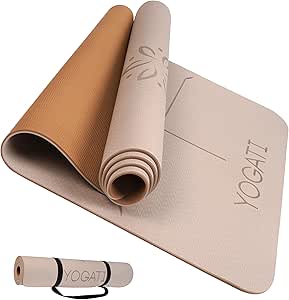 | Best for Alignment Cues | Material: Thermoplastic elastomers (TPE) | Dimensions: 72 × 24 inches | Thickness: 0.24 inches | VIEW ON AMAZON | See Our Full Breakdown |
| Gruper Eco-Friendly TPE Yoga Mat with Carrying Strap and Bag |  | Best TPE Option with Two Thicknesses | Material: Thermoplastic elastomers (TPE) | Standard dimensions: 72 × 24 × 0.24 inches (6mm) | Thickened dimensions: 72 × 24 × 0.32 inches (8mm) | VIEW ON AMAZON | See Our Full Breakdown |
| yoga mat for beginners non slip | Material | Thickness | Dimensions | Weight |
|---|---|---|---|---|
| Gaiam Yoga Mat Classic Print | Polyvinyl Chloride (PVC) | 4mm (0.16 inches) | 68 x 24 inches | 2.1 pounds |
| Gaiam Yoga Mat | Polyvinyl Chloride (PVC) | 6mm | 68 x 24 inches | 3.1 pounds |
| Amazon Basics 1/4 Inch Thick T | TPE | 0.24 inches (approximately 1/4 inch) | 73.6 x 24 inches | 0.91 kg |
| Fitvids 1/4-inch Thick High De | Foam | 0.25 inch | 68 x 24 inches | 1.5 pounds |
| Circuit Fitness by Marcy Non-S | Thermoplastic elastomers (TPE) | 0.25 inch | 74 x 24 inches | 1.5 pounds |
| Gaiam Essentials 1/4" | Polyvinyl chloride (PVC) | 1/4 inch (6mm) | 72 × 24 inches | 3.5 pounds |
| Gaiam Thick Yoga Mat with Easy | Nitrile butadiene rubber (NBR) | 10mm (0.39 inches) | 72 × 24 inches | 2.8 pounds |
| Gaiam Premium Yoga Mat | Polyvinyl chloride (PVC) | 6mm | 68 × 24 inches | 3.1 pounds |
| YOGATI Yoga Mat with Strap and | Thermoplastic elastomers (TPE) | 0.24 inches | 72 × 24 inches | 820g |
| Gruper Eco-Friendly TPE Yoga M | Thermoplastic elastomers (TPE) | — | — | — |
More Details on Our Top Picks
Gaiam Yoga Mat Classic Print, 4mm Non-Slip Mat
The Gaiam Classic Print is a straightforward starter choice for beginners who want a textured surface and a mat that is easy to carry. At 2.1 pounds, it is lighter than the 6mm Gaiam Premium, though its 4mm padding gives up some joint cushioning in return. The grippy texture is a practical plus for learning steady poses, but the provided details do not specify how the surface performs when very wet, so it may not suit especially sweaty sessions. Its 68-by-24-inch size fits a familiar studio footprint, and downloadable classes can give a new student a place to start. The PVC construction is a tradeoff for buyers seeking alternatives to PVC; the mat may also smell after opening and can be affected by prolonged sun exposure.
Pros:- Textured surface is designed to support grip during poses.
- Light 2.1-pound build is convenient for carrying to class.
- Downloadable yoga classes offer a useful starting point for new practitioners.
Cons:- At 4mm, it offers less cushioning than the 6mm Gaiam Premium.
- PVC may not suit buyers seeking a non-PVC mat.
- May have an initial odor and can fade or become brittle with extended sun exposure.
Best for: Beginners who want a light, easy-to-carry mat for home practice, studio classes, and lower-impact workouts.
Not ideal for: People who need extra padding for sensitive knees, prefer to avoid PVC, or plan to store their mat in direct sunlight.
- Material:Polyvinyl Chloride (PVC)
- Thickness:4mm (0.16 inches)
- Dimensions:68 x 24 inches
- Weight:2.1 pounds
- Color:Pink Marrakesh
- Surface:Textured non-slip surface
- Included:Downloadable yoga classes
Our verdict“Choose this Gaiam if portability and a textured beginner-friendly surface matter more than extra joint padding.”
Gaiam Yoga Mat – Premium 6mm Reversible Non-Slip Exercise & Fitness Mat for Yoga, Pilates & Floor Workouts (68″ x 24″ x 6mm)
For beginners who find firm floors uncomfortable, the Gaiam Premium 6mm adds padding without changing the standard 68-by-24-inch footprint. Its reversible textured surfaces give the mat two usable sides, while the 6mm thickness offers more cushioning than the thinner Classic Print. That extra support can help during kneeling or seated work, though it also weighs a pound more than the 4mm Gaiam and may feel less appealing to someone carrying a mat every day. The product description identifies it as PVC and claims it is free of harmful chemicals; buyers who specifically want a non-PVC material may prefer the TPE Amazon Basics mat instead. A downloadable class is a beginner-friendly extra, but the listed information does not establish a specific grip advantage for sweaty practice.
Pros:- 6mm thickness provides more cushioning than the 4mm Gaiam Classic Print.
- Reversible textured surfaces offer two sides for practice.
- Downloadable yoga class can help beginners get started.
Cons:- At 3.1 pounds, it is heavier than the Gaiam Classic Print.
- PVC construction may not fit a non-PVC material preference.
- Limited color options reduce choice.
Best for: New yoga students who practice on firm floors and want more padding for kneeling, seated poses, and general workouts.
Not ideal for: Commuters prioritizing the lightest mat or buyers who want a non-PVC material.
- Material:Polyvinyl Chloride (PVC)
- Thickness:6mm
- Dimensions:68 x 24 inches
- Weight:3.1 pounds
- Color:Lunar Wave
- Surface:Reversible textured non-slip surfaces
- Included:Downloadable yoga class
Our verdict“Pick this model over the thinner Gaiam Classic Print when joint cushioning matters more than carrying weight.”
Amazon Basics 1/4 Inch Thick TPE Exercise Yoga Mat with Carrying Strap
The Amazon Basics TPE mat stands out for its 73.6-inch length, which gives taller beginners more room than the 68-inch Gaiam Classic Print and Fitvids mats. Its 1/4-inch cushioning is close to the thickness of those options, so it offers a familiar balance of padding and floor contact rather than the extra softness of the 6mm Gaiam Premium. The non-slip surface is intended to support stability, while the included strap and 0.91kg weight make it practical to carry. TPE also gives buyers a material alternative to the PVC Gaiam mats. The tradeoff is care: this mat is hand-wash only, and the product description says its cushioning may not be enough for high-impact exercise. It is a better fit for yoga and Pilates than jumping workouts.
Pros:- 73.6-inch length offers more room than the 68-inch Gaiam and Fitvids mats.
- TPE construction provides an alternative to the PVC Gaiam models.
- Carrying strap and 0.91kg weight support portability.
Cons:- Hand-wash-only care takes more attention than a simple machine-wash option.
- The 1/4-inch thickness may not cushion high-impact activity enough.
- Limited color options.
Best for: Taller beginners who want extra mat length, a carrying strap, and a TPE alternative to PVC.
Not ideal for: People seeking machine-washable care, substantial padding for high-impact workouts, or broad color selection.
- Material:TPE
- Thickness:0.24 inches (approximately 1/4 inch)
- Dimensions:73.6 x 24 inches
- Weight:0.91 kg
- Color:Plum
- Surface:Non-slip
- Included:Carrying strap
- Care:Hand wash only
Our verdict“Choose this mat if you are taller than average and want a portable TPE option for yoga rather than high-impact training.”
Fitvids 1/4-inch Thick High Density Exercise Yoga Mat with Carrying Strap
The Fitvids foam mat suits beginners who want a simple, lightweight option with a carrying strap and a moisture-resistant surface. At 1.5 pounds, it is lighter than either Gaiam mat in this lineup, while its 1/4-inch thickness sits between the 4mm Classic Print and the 6mm Gaiam Premium for padding. The high-density foam is described as providing comfort and stability, but some users may find the cushioning less substantial than expected, especially on hard floors. Compared with the longer Amazon Basics TPE mat, Fitvids is shorter at 68 inches and uses foam rather than TPE. Its non-slip surfaces are a useful feature for basic practice, but buyers who need extra knee protection should favor the thicker Gaiam Premium. The blue-only color choice also limits personalization.
Pros:- Light 1.5-pound build is easier to carry than either Gaiam mat listed here.
- Moisture-resistant, non-slip surfaces are suited to general exercise.
- Carrying strap supports transport and storage.
Cons:- Some users may find the cushioning inadequate on very hard floors.
- At 68 inches, it is shorter than the 73.6-inch Amazon Basics mat.
- Available only in blue.
Best for: Beginners who want a lightweight foam mat with a strap for basic yoga, stretching, and floor exercises.
Not ideal for: People who need generous cushioning on hard floors, want a longer mat, or prefer several color choices.
- Material:Foam
- Thickness:0.25 inch
- Dimensions:68 x 24 inches
- Weight:1.5 pounds
- Color:Blue
- Surface:Non-slip and moisture-resistant
- Density:High density
- Included:Carrying strap
Our verdict“Choose Fitvids for a lightweight, strap-equipped foam mat if portability matters more than extra cushioning or length.”
Circuit Fitness by Marcy Non-Slip Multi-Purpose Exercise Yoga Mat with Carrying Strap
The Circuit Fitness by Marcy mat is a flexible choice for beginners who plan to alternate yoga with stretching, Pilates, or strength work. Its 74-inch length gives more coverage than the Fitvids and both Gaiam mats listed here, and the 1.5-pound weight plus carrying strap make it easy to roll up and take along. The 0.25-inch thickness provides a basic layer of cushioning, but it will not match the joint padding of the 6mm Gaiam Premium, and the listing warns that it is not intended to absorb high-impact activity. A moisture-resistant TPE surface may make cleanup easier after varied workouts; compared with the Amazon Basics TPE mat, this one is also longer. Buyers who want more than the single mint-green color or deep cushioning should look elsewhere.
Pros:- 74-inch length provides more coverage than the other listed mats.
- Moisture-resistant TPE surface suits a mix of workouts and easier cleanup.
- Lightweight 1.5-pound design includes a carrying strap.
Cons:- 0.25-inch thickness may not provide enough cushioning for high-impact activity.
- Less joint padding than the 6mm Gaiam Premium.
- Limited color options.
Best for: Beginners who want one portable mat for yoga, Pilates, stretching, and low-impact strength sessions.
Not ideal for: People who need extra cushioning for sensitive joints, plan high-impact workouts, or want multiple color choices.
- Material:Thermoplastic elastomers (TPE)
- Thickness:0.25 inch
- Dimensions:74 x 24 inches
- Weight:1.5 pounds
- Color:Mint Green
- Surface:Moisture-resistant
- Use:Yoga, Pilates, stretching, and strength training
- Included:Carrying strap
Our verdict“Pick the Circuit Fitness mat if you want a lightweight, longer TPE surface for yoga and varied low-impact workouts.”
Gaiam Essentials 1/4″ (6mm) Yoga & Pilates Exercise Mat with Carrying Strap
The Gaiam Essentials 6mm is a practical starting point for beginners who want joint cushioning without a bulky mat. Its textured surface is designed to help hold footing during basic poses, while the carrying sling makes it easier to bring to class. Compared with the Gaiam Thick Yoga Mat, this model is thinner and firmer underfoot, which can make balance poses feel less wobbly, though it offers less padding for kneeling or floor work. At 72 by 24 inches, it provides a familiar full-length practice area. The main compromise is its PVC construction, which may not suit buyers seeking an alternative material. Choose it for straightforward portability and cushioning; skip it if plush support or non-PVC materials are priorities.
Pros:- 6mm thickness adds cushioning for knees and other pressure points
- Textured surface is designed to provide traction
- Carrying sling and 3.5-pound weight support portability
- 72-inch length suits many standard home and studio practices
Cons:- PVC material may not fit buyers seeking a non-PVC option
- Less cushioned than the 10mm Gaiam Thick Yoga Mat
- Only one listed color limits choice
Best for: Beginners who want a portable, 6mm mat with moderate cushioning for studio classes and home practice
Not ideal for: Buyers who want plush joint padding or prefer a mat made without PVC
- Material:Polyvinyl chloride (PVC)
- Dimensions:72 × 24 inches
- Thickness:1/4 inch (6mm)
- Weight:3.5 pounds
- Color:Teal
- Surface:Textured, non-slip
- Included accessory:Carrying sling
Our verdict“Choose this for a portable, moderately cushioned beginner mat, but pick the Gaiam Thick Yoga Mat if extra padding matters more than a firmer feel.”
Gaiam Thick Yoga Mat with Easy-Cinch Carrying Strap
For beginners who find kneeling poses uncomfortable, the 10mm NBR foam on this Gaiam offers substantially more padding than the 6mm Gaiam Essentials or Premium Yoga Mat. That softness can make floor sequences easier on sensitive knees, while its textured surface is intended to help with grip. The tradeoff is a less firm base: compared with the thinner YOGATI mat, this one may feel less steady when holding balance poses. Its 2.8-pound weight and cinch strap keep it portable for a mat this thick, though it takes up more space when rolled. The description notes a possible initial odor, and the foam’s softness will not suit everyone. I’d pick it for comfort-focused home practice, not for buyers who prioritize a firm, compact mat.
Pros:- 10mm foam gives more cushioning than the lineup’s 6mm mats
- Textured surface is designed to support traction
- Includes a carrying strap and weighs 2.8 pounds
- NBR foam is described as low-odor and easy to clean
Cons:- Soft foam may feel unstable during balance poses
- Bulkier to roll and store than thinner mats
- May have an initial odor
Best for: New practitioners with sensitive knees or wrists who mostly practice floor-based yoga and Pilates at home
Not ideal for: People focused on standing balance poses, a firm surface, or compact storage
- Material:Nitrile butadiene rubber (NBR)
- Dimensions:72 × 24 inches
- Thickness:10mm (0.39 inches)
- Weight:2.8 pounds
- Color:Green
- Surface:Textured, non-slip
- Included accessory:Easy-cinch carrying strap
Our verdict“Pick this Gaiam if extra padding is your priority; choose the thinner YOGATI or Gaiam Essentials for a firmer feel underfoot.”
Gaiam Premium Yoga Mat, 6mm Thick Print Mat
The Gaiam Premium 6mm Print Mat suits beginners who want a standard-cushion mat and a simple way to start practicing: it includes access to a downloadable yoga class. Its textured surface is intended to provide grip, and the 6mm build gives more joint padding than a thinner 4mm option such as the Gaiam Classic Print Mat. Compared with the Gaiam Essentials, it is slightly shorter at 68 inches and a little lighter at 3.1 pounds, which may help with carrying but leaves less room for taller users. The PVC construction is listed as non-toxic, though shoppers specifically seeking non-PVC materials may prefer the Gruper TPE mat. A possible odor when first unwrapped is another drawback. This is a reasonable match for guided home practice, not a long-mat seeker.
Pros:- 6mm thickness offers cushioning for joints during floor poses
- Textured surface is designed to support grip
- Includes access to a downloadable yoga class
- Weighs 3.1 pounds for easier carrying
Cons:- 68-inch length is shorter than the Gaiam Essentials and Gruper mats
- PVC may not suit buyers seeking a non-PVC material
- May have an odor when first unwrapped
Best for: New home practitioners who want 6mm cushioning and a downloadable class to help start a routine
Not ideal for: Taller users who want a 72-inch mat or buyers specifically seeking TPE instead of PVC
- Material:Polyvinyl chloride (PVC)
- Thickness:6mm
- Dimensions:68 × 24 inches
- Weight:3.1 pounds
- Color:Sublime Sky
- Surface:Textured, non-slip
- Included extra:Downloadable yoga class
Our verdict“Choose this for guided beginner practice on a cushioned mat, but opt for the Gaiam Essentials if you need the longer 72-inch surface.”
YOGATI Yoga Mat with Strap and Alignment Lines for Home Workout, Non-Slip, Thick Foam for Pilates and Fitness – Brown, Pink, Purple
The YOGATI stands apart from the plain-surface mats here with built-in alignment lines, which give new practitioners a visible reference for hand and foot placement. That can be useful when learning poses at home without an instructor nearby. At 72 by 24 inches and 820g, it is notably light, while its 0.24-inch TPE construction supplies some joint cushioning without the bulk of the 10mm Gaiam Thick Yoga Mat. The textured, reversible surface is described as suitable for sweaty workouts, but the listing does not provide a specific grip test or rating. Compared with the Gruper TPE mat, YOGATI offers alignment marks and similar standard thickness; Gruper instead lists a thicker option and a storage bag. This is a focused pick for form cues, though users seeking a firmer surface may find its padding too soft.
Pros:- Alignment lines offer visual guidance for hand and foot placement
- Textured, reversible surface is described as suitable for sweaty workouts
- Lightweight at 820g and includes a carrying strap
- TPE material and 72-inch length suit portable home practice
Cons:- 0.24-inch thickness offers less padding than the 10mm Gaiam Thick Yoga Mat
- May feel too soft for users who prefer a firmer surface
- Listed color options are limited
Best for: Beginners practicing at home who want visual placement cues and a lightweight TPE mat
Not ideal for: Practitioners who prefer a firm base, need extra-thick padding, or want a storage bag included
- Material:Thermoplastic elastomers (TPE)
- Dimensions:72 × 24 inches
- Thickness:0.24 inches
- Weight:820g
- Listed color:Brown
- Surface:Textured and reversible
- Included accessory:Carrying strap
Our verdict“Choose YOGATI if placement cues matter most; choose the Gruper TPE mat if you want a listed thicker option and a storage bag.”
Gruper Eco-Friendly TPE Yoga Mat with Carrying Strap and Bag
The Gruper gives beginners a material and sizing choice that most options here do not: it comes in 6mm and 8mm TPE versions, so buyers can choose between a lighter, lower-profile mat and added padding. Its double-layer, two-sided textured design is intended to support grip and resist tearing, while the included strap and storage bag make carrying and storing it straightforward. Compared with the YOGATI, Gruper offers a listed thicker size and bag, but it lacks YOGATI’s alignment lines. The standard version weighs 2.6 pounds; the thicker one rises to 3.1 pounds. Care is less convenient than for a mat described as easy to clean: Gruper calls for hand washing and drying flat, and its surface may be harmed by shoes or pet claws. It also should not sit in direct sunlight for extended periods.
Pros:- Available in standard 6mm and thicker 8mm versions
- TPE material is described as non-toxic and odorless
- Double-layer construction has textured surfaces on both sides
- Includes both a carrying strap and storage bag
Cons:- Requires hand washing and flat drying
- Surface may be damaged by shoes or pet claws
- Should not be left in direct sunlight for extended periods
Best for: Beginners who want a non-PVC TPE mat, a choice of thickness, and a bag for transport or storage
Not ideal for: People who need machine-washable equipment or regularly practice outdoors around shoes, pets, or strong sun
- Material:Thermoplastic elastomers (TPE)
- Standard dimensions:72 × 24 × 0.24 inches (6mm)
- Thickened dimensions:72 × 24 × 0.32 inches (8mm)
- Standard weight:2.6 pounds
- Thickened weight:3.1 pounds
- Color:Grey Blue / Black
- Included accessories:Carrying strap and storage bag
- Care:Hand wash with a damp cloth and mild detergent; dry flat
Our verdict“Pick Gruper for TPE, thickness choice, and included storage gear; choose YOGATI instead if alignment lines are more useful than a bag.”

How We Picked
I ranked these mats around the needs of a beginner: dependable-feeling traction, enough cushioning for floor poses, and a surface that does not make basic standing positions feel needlessly difficult. I also weighed practical details such as thickness, carrying straps or bags, design features, and versatility for yoga, Pilates, or general floor exercise. A non-slip claim alone cannot establish how a surface will feel for every user, so I treated material and construction as useful clues rather than a promise of performance.
The order reflects the balance of these factors, not a single spec. The Gaiam Premium 6mm Reversible leads for combining cushioning and a choice of surfaces; the Amazon Basics TPE and other carry-ready mats suit buyers who value uncomplicated setup and transport. Specialized benefits, such as YOGATI’s alignment lines or a thicker design for extra padding, earn a place for specific needs, while thinner or less differentiated choices rank lower for a first-mat shortlist. I also account for tradeoffs: more thickness can soften balance, and an included strap does not by itself make a mat lighter or more compact.
| yoga mat for beginners non slip | Material | Included |
|---|---|---|
| Gaiam Yoga Mat Classic Print | Polyvinyl Chloride (PVC) | Downloadable yoga classes |
| Gaiam Yoga Mat | Polyvinyl Chloride (PVC) | Downloadable yoga class |
| Amazon Basics 1/4 Inch Thick T | TPE | Carrying strap |
| Fitvids 1/4-inch Thick High De | Foam | Carrying strap |
| Circuit Fitness by Marcy Non-S | Thermoplastic elastomers (TPE) | Carrying strap |
| Gaiam Essentials 1/4" | Polyvinyl chloride (PVC) | — |
| Gaiam Thick Yoga Mat with Easy | Nitrile butadiene rubber (NBR) | — |
| Gaiam Premium Yoga Mat | Polyvinyl chloride (PVC) | — |
| YOGATI Yoga Mat with Strap and | Thermoplastic elastomers (TPE) | — |
| Gruper Eco-Friendly TPE Yoga M | Thermoplastic elastomers (TPE) | — |
Factors to Consider When Choosing Yoga Mat For Beginners Non Slip
Before choosing, I’d match the mat to the practice you expect to do most often rather than chasing the longest feature list. These broader factors can help you judge grip claims, avoid buying too much or too little cushioning, and decide which conveniences are worth prioritizing.
Choose Thickness for the Poses You Practice
Thickness is a comfort-versus-stability decision, not a simple measure of quality. A thicker mat can soften pressure on knees during kneeling poses and floor work, while a thinner surface may feel more connected to the floor in standing balance poses. Beginners who plan to mix gentle yoga with Pilates may prefer extra cushioning, but those who wobble in tree pose may find a very soft feel distracting. Check the stated thickness and think about the floor beneath it; carpet already adds give, while a hard floor makes cushioning more noticeable. A common mistake is choosing the thickest option without considering whether it will make standing poses feel less steady.
Treat Non-Slip as a Surface-and-Setup Question
A mat marked non-slip is not a guarantee against sliding in every class or room. Grip can feel different with dry hands, sweaty palms, dust, cleaning residue, and the type of floor underneath. If you tend to sweat, check care guidance and consider whether the surface is easy to wipe down; residue from unsuitable cleaners can affect feel. At home, test the mat on the floor where you will practice, since a mat that stays put on one surface may shift on another. Buyers often focus only on hand grip and overlook whether the mat itself slides across the floor.
Compare Material by Feel and Care, Not Just Its Label
Materials such as TPE and foam can differ in texture, weight, cushioning, and cleaning needs, so the name alone does not settle which mat will feel best. If possible, look for clear care instructions and surface details before buying, especially if regular cleaning is part of your routine. A mat used for sweaty sessions may need more frequent wiping than one reserved for gentle stretching. Some buyers also prefer a particular material for environmental or personal reasons, but broad claims should be checked against the product’s specific description. Prioritize a surface you can maintain consistently over a label that sounds reassuring but says little about day-to-day use.
Decide Whether You Need Alignment Marks
Printed alignment lines can help beginners check hand and foot placement without relying on a mirror or instructor in every session. They are most useful if you practice at home and are still learning basic positioning. They are less important if you attend guided classes, already know your preferred stance, or find markings visually distracting. Lines can act as a reference, but they do not replace instruction or guarantee correct form for every body. Think of them as a learning aid rather than a feature that makes the mat itself more grippy or supportive.
Be Realistic About Carrying and Storage
A strap or bag makes a rolled mat easier to carry, but it does not tell you how heavy or bulky the mat will feel on a commute. If you walk or use transit to class, look for the mat’s weight and rolled dimensions where available, not just the included accessory. For home practice, storage space and how quickly the mat unrolls may matter more than a carrying strap. Thicker mats can take up more room, while a thinner mat may be easier to stow but less comfortable on hard floors. Match the accessory to your routine instead of treating it as proof of portability.
Pay More for a Benefit You Will Actually Use
A premium or feature-rich mat makes sense when its specific advantages solve a recurring problem, such as wanting reversible surfaces or extra cushioning. A beginner who is still building a practice may get more value from a simple, comfortable mat than from features that remain unused. Conversely, choosing only by low cost can lead to a mat that feels too thin or lacks a carrying option you need. Compare the overall design, included accessories, and intended workouts before deciding what level of investment fits. The best first mat is the one that supports regular practice without adding avoidable friction.
Frequently Asked Questions
Which mat is the safest starting point if I am unsure what thickness I need?
I’d begin with a 6mm option if you expect to practice on a hard floor and want a middle ground between cushioning and floor contact. The Gaiam Premium 6mm Reversible is a strong all-purpose starting point in this lineup because it also gives you two surfaces to choose from. If your main concern is balance, compare it with the thinner 4mm Gaiam Classic Print rather than assuming more padding is always better. If you have sensitive knees, extra cushioning may matter more than a very direct floor feel. Your practice surface and preferred poses should guide the final choice.
Will a non-slip yoga mat stop my hands from sliding when I sweat?
No mat can promise that your hands will never slide, particularly during warm or sweaty practice. Surface material, moisture, cleaning residue, and personal grip all affect how traction feels. Check the product’s care guidance and clean the mat as directed, since buildup can change the surface. If you know you sweat heavily, look for detailed information about the mat’s texture and consider whether you may want a towel as an additional layer. A non-slip label is a useful starting point, not a substitute for matching the surface to your practice.
Is a thicker mat better for a beginner who has sore knees?
Extra thickness can make kneeling and seated poses more comfortable on a hard floor, so it may help if knee pressure is your main concern. It can also make standing balance poses feel softer or less stable, which some beginners find distracting. Consider whether your sessions include more floor work or more standing sequences before choosing. If you practice on carpet, the floor already provides some cushioning, so a very thick mat may be unnecessary. Comfort is personal, and persistent pain is a reason to adjust poses or seek guidance rather than relying on a mat alone.
Do alignment lines make a meaningful difference for home practice?
They can be helpful when you are learning where to place your hands and feet, especially when practicing without a teacher nearby. In this roundup, YOGATI’s printed alignment lines give it a clear advantage for that use. They are reference marks, not a form correction system, and body proportions or pose variations may call for a different position. If you already have a routine or prefer an uncluttered surface, the lines may add little value. Choose them when visual cues support your learning style, not simply because they are an extra feature.
Should I prioritize a carrying strap or a lighter mat for taking it to class?
A strap makes a rolled mat easier to hold, but it does not reduce the mat’s weight or size. For a short walk from home to a studio, an included strap may be enough; for a longer commute, weight and rolled dimensions matter more. Check those specifications when available, since thickness can affect how bulky a mat is to carry. If you mostly practice at home, storage space may matter more than either accessory. The Amazon Basics, Fitvids, Circuit Fitness, Gaiam Essentials, and Gruper options include carrying accessories, but compare the mat itself before treating them as equally portable.
Conclusion
For most first-time buyers, I’d choose the Gaiam Premium 6mm Reversible as the best overall option because it combines cushioning with a choice of surfaces. For a straightforward, carry-ready pick, the Amazon Basics 1/4-Inch TPE Mat is my best value direction; for a beginner who wants more padding, the Gaiam Essentials 6mm is a practical place to start. Buyers seeking a more feature-focused premium option can compare the Gaiam Premium models, while YOGATI is the specialist choice for alignment cues at home. Choose the thinner Gaiam Classic Print 4mm if a closer-to-the-floor feel matters more than added cushioning, and check care and grip details before deciding if sweaty practice is your main concern.
Halloween Picks
halloween
As an affiliate, we earn on qualifying purchases.